

 Back to Blog Page

Introduction
Building healthcare software isn’t like building other applications.
Get it wrong, and you’re not just dealing with unhappy users—you’re facing:
- $50,000 approx. + HIPAA violation fines (per incident)
- Legal liability for data breaches
- Loss of patient trust
- Damaged reputation that can destroy your business
But get it right, and you have a competitive moat. HIPAA compliance isn’t easy, which means fewer competitors can do it well.
In this guide, you’ll learn:
- What HIPAA actually requires (in plain English)
- How AI features complicate compliance
- The 5 technical requirements for HIPAA-compliant apps
- Real costs and timelines
- Common mistakes that lead to violations
Whether you’re building a telemedicine platform, patient portal, or AI diagnostic tool, this guide will help you build it compliantly-the first time.
What is HIPAA and Why Does It Matter?
HIPAA = Health Insurance Portability and Accountability Act
Passed in 1996, HIPAA protects patient health information (PHI) from unauthorized access, use, or disclosure.
What counts as PHI?
Any information that can identify a patient and relates to their health:
- Medical records and test results
- Treatment plans and prescriptions
- Billing and insurance information
- Appointment schedules
- Even photos if they show medical conditions
Who must comply?
- Healthcare providers (doctors, hospitals, clinics)
- Health plans (insurance companies)
- Healthcare clearinghouses
- Business Associates (that’s YOU if you’re building healthcare software)
The Business Associate Agreement (BAA):
Before handling any PHI, you must sign a BAA with your healthcare client. This legally obligates you to:
- Protect PHI with specific security measures
- Report breaches within 60 days
- Allow audits of your security practices
- Ensure all subcontractors also comply
Penalties for violations:
- Tier 1 (unaware): around $100-$50,000 per violation
- Tier 2 (reasonable cause): around $1,000-$50,000 per violation
- Tier 3 (willful neglect, corrected): around $10,000-$50,000 per violation
- Tier 4 (willful neglect, not corrected): around $50,000 per violation
- Maximum annual penalty: $1.5 million approx. per violation type
One data breach affecting 1,000 patients? That’s potentially around $50 million in fines.
HIPAA compliance isn’t optional. It’s the foundation.
The 5 Technical Requirements for HIPAA Compliance
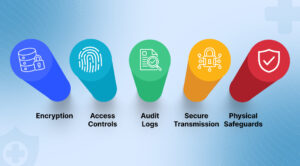
1. Encryption (Data at Rest and in Transit)
What it means: All PHI must be encrypted whether stored in databases or transmitted between systems.
Technical requirements:
- Database encryption: AES-256 encryption for all PHI fields
- File encryption: Medical images, PDFs, documents encrypted on servers
- Transmission encryption: TLS 1.2+ for all API calls and data transfers
- Backup encryption: All backups must be encrypted
Implementation:
Database: PostgreSQL with pgcrypto extension
File storage: AWS S3 with server-side encryption (SSE-S3)
API: HTTPS only, TLS 1.3 preferred
Mobile apps: Certificate pinning to prevent man-in-the-middle attacks
Cost impact: Around +$3,000-5,000 for proper encryption implementation
2. Access Controls and Authentication
What it means: Only authorized users can access PHI, and access must be tracked and limited.
Technical requirements:
- Multi-factor authentication (MFA): Required for all PHI access
- Role-based access control (RBAC): Doctors see different data than nurses, admins, or patients
- Minimum necessary standard: Users only access PHI needed for their job
- Automatic logout: Sessions expire after 15 minutes of inactivity
- Strong passwords: Enforce complexity requirements
Implementation:
Authentication: OAuth 2.0 + JWT tokens
MFA: SMS or authenticator app (Google Authenticator, Authy)
Session management: Redis with 15-minute timeout
Password requirements: 12+ characters, mixed case, numbers, symbols
Failed login attempts: Lock account after 5 failed attempts
Cost impact: Around +$2,000-4,000 for MFA and access control systems
3. Comprehensive Audit Logs
What it means: Every access, modification, or deletion of PHI must be logged and retained for 6 years.
What to log:
- Who accessed PHI (user ID, role)
- What PHI was accessed (patient ID, record type)
- When it was accessed (timestamp)
- What action was taken (view, edit, delete, export)
- Where they accessed from (IP address, device)
- Why (if applicable – reason for access)
Technical requirements:
- Immutable logs (cannot be edited or deleted)
- Encrypted log storage
- 6-year retention minimum
- Searchable and exportable for audits
Implementation:
Logging: AWS CloudWatch or ELK Stack (Elasticsearch, Logstash, Kibana)
Storage: Separate database from application, write-only access
Monitoring: Real-time alerts for suspicious activity
Retention: Automated archival to cold storage after 1 year
Cost impact: Around +$2,000-3,000 for audit logging infrastructure
4. Secure Data Transmission
What it means: PHI cannot be sent via unsecured channels (email, SMS, unencrypted APIs).
Technical requirements:
- APIs: All endpoints must use HTTPS with TLS 1.2+
- Email: Encrypted email only (not standard Gmail/Outlook)
- SMS: Cannot contain PHI (use secure app notifications instead)
- Fax: Still used in healthcare, must use encrypted digital fax services
- File transfers: SFTP or encrypted cloud services only
Implementation:
API security: API Gateway with WAF (Web Application Firewall)
Email: Paubox, Hushmail, or other HIPAA-compliant email services
In-app messaging: End-to-end encrypted messaging within app
File sharing: Secure portal with encrypted uploads/downloads
Third-party integrations: All vendors must be HIPAA compliant
Cost impact: Around +$1,000-2,000 for secure transmission infrastructure
5. Physical and Administrative Safeguards
What it means: Servers, backups, and physical access to systems must be secured.
Technical requirements:
- Cloud hosting: Use HIPAA-compliant cloud providers (AWS, Azure, GCP with BAA)
- Data centers: Must meet HIPAA physical security standards
- Workstation security: Encrypted hard drives, screen locks, secure disposal
- Policies and procedures: Written security policies, employee training
- Business Associate Agreements: All vendors must sign BAAs
Implementation:
Hosting: AWS with signed BAA (required)
Infrastructure: Private subnets, VPC, security groups
Disaster recovery: Multi-region backups, tested recovery procedures
Vendor management: Maintain list of all BAAs, annual reviews
Employee training: Annual HIPAA training for all team members
Cost impact: Around +$3,000-5,000 for compliant infrastructure and training
Total HIPAA compliance cost: Around +$11,000-$19,000 on top of base development
How AI Complicates HIPAA Compliance
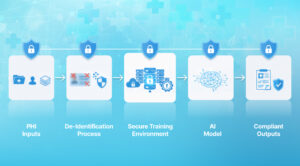
AI-powered healthcare apps are powerful—but they introduce new compliance challenges:
Challenge 1: Training Data Must Be De-Identified
The problem:
AI models need large datasets to train effectively. But using real PHI for training violates HIPAA unless properly de-identified.
The solution:
- Remove 18 specific identifiers (names, addresses, dates, phone numbers, etc.)
- Use synthetic data generation for training
- Implement “Safe Harbor” or “Expert Determination” de-identification methods
- Maintain audit trail of de-identification process
Example: Training an AI to detect pneumonia from X-rays requires thousands of images. Each image must have patient identifiers stripped and replaced with anonymous IDs.
Challenge 2: AI Decisions Must Be Explainable
The problem:
“Black box” AI decisions in healthcare can lead to liability issues and don’t meet clinical standards.
The solution:
- Use explainable AI (XAI) techniques
- Document decision-making logic
- Provide confidence scores
- Allow clinicians to override AI recommendations
- Maintain human-in-the-loop for final decisions
Example: An AI suggesting a diagnosis must show which symptoms/test results led to that conclusion, not just output a result.
Challenge 3: Third-Party AI APIs
The problem:
Using OpenAI, Google AI, or other third-party APIs means sending PHI to external services.
The solution:
- Only use vendors with signed BAAs (OpenAI offers enterprise BAA)
- De-identify data before sending to APIs
- Use on-premise AI models for sensitive operations
- Document all third-party AI usage in security documentation
Cost impact: Using HIPAA-compliant AI APIs adds $5,000-$15,000 approx. to project costs.
Real Project Example: Telemedicine Platform
Client: Regional healthcare network
Project: HIPAA-compliant telemedicine platform with AI-powered triage
Timeline: 18 weeks
Cost: $142,000 approx.
Features built:
- Video consultation (Zoom Healthcare API – HIPAA compliant)
- Patient portal with medical history
- AI symptom checker (de-identified training data)
- E-prescription integration (SureScripts)
- Appointment scheduling
- Secure messaging between patients and providers
- Mobile apps (iOS and Android)
HIPAA compliance implementation:
- AES-256 database encryption
- MFA for all users
- Comprehensive audit logging
- BAAs with all vendors (Zoom, Twilio, AWS, SureScripts)
- Annual security risk assessment
- Staff HIPAA training program
Compliance cost breakdown:
- Base platform: around $115,000
- HIPAA compliance features: around $15,000
- AI de-identification system: around $8,000
- Legal/BAA reviews: around $4,000
Result: Platform launched on time, passed initial HIPAA audit, now serves 10,000+ patients with zero violations.
Common HIPAA Mistakes That Lead to Violations

- Sending PHI via regular email ❌ “Can you send me John Smith’s lab results?” ✓ Use encrypted patient portal or HIPAA-compliant email
- Inadequate access controls ❌ All staff can see all patient records ✓ Role-based access – users only see what they need
- No audit logging ❌ Can’t prove who accessed which records ✓ Comprehensive, immutable audit logs
- Using non-compliant vendors ❌ Regular Zoom, Dropbox, or Google Drive for PHI ✓ Only HIPAA-compliant vendors with signed BAAs
- Missing BAAs ❌ Vendor handles PHI without signed agreement ✓ BAA signed BEFORE any PHI is shared
- Weak passwords and no MFA ❌ “Password123” ✓ Strong passwords + multi-factor authentication
- Unencrypted backups ❌ PHI backups stored in plaintext ✓ All backups encrypted at rest
One violation can cost $50,000+ approx. Prevention is always cheaper than penalties.
Building AI Features Compliantly: Step-by-Step
Step 1: De-Identify Training Data
Strip all 18 HIPAA identifiers from datasets before AI training
Step 2: Secure Your AI Infrastructure
- Use HIPAA-compliant cloud services (AWS SageMaker with BAA)
- Encrypt all training data
- Restrict access to AI models
Step 3: Implement Explainable AI
- Document how AI makes decisions
- Provide confidence scores
- Allow clinical override
Step 4: Validate AI Accuracy
- Clinical validation by licensed professionals
- Document accuracy rates
- Regular model retraining and testing
Step 5: Get BAAs from AI Vendors
- OpenAI Enterprise (with BAA)
- Google Cloud AI (with BAA)
- Or use on-premise models
Step 6: Document Everything
- AI decision logic
- Training data sources
- Validation results
- Ongoing monitoring procedures
AI compliance adds 2-3 weeks to development timeline and around $8,000-$20,000 to costs.
Conclusion:
Compliance is Your Competitive Advantage
HIPAA compliance isn’t easy. But that’s exactly why it’s valuable.
Most developers avoid healthcare because compliance is complex and expensive. That creates opportunity for those who do it right.
Building HIPAA-compliant software with AI features requires:
- Deep technical expertise
- Understanding of healthcare regulations
- Experience with compliant infrastructure
- Relationships with HIPAA-compliant vendors
At JournAI, we’ve built 15+ HIPAA-compliant healthcare applications. We know the requirements, the pitfalls, and how to build medical software that patients and doctors trust.
Ready to discuss your healthcare software project?
FAQs
Q: Do I need HIPAA compliance if I’m just storing names and emails?
A: If those names and emails are connected to health information (appointment dates, medical conditions, etc.), yes. Any information that can identify a patient and relates to their health is PHI.
Q: Can I use regular AWS or do I need special HIPAA hosting?
A: You can use regular AWS services, but you MUST sign a Business Associate Agreement with AWS first. Not all AWS services are HIPAA-eligible—check their compliance documentation.
Q: How much does HIPAA compliance add to development costs?
A: Typically around $11,000-$19,000 for basic compliance. Add around $8,000-$20,000 if using AI features. Total project minimums usually start around $55,000 for simple HIPAA apps.
Q: Can I build a HIPAA app with a around $10/hour overseas developer?
A: Technically possible, but extremely risky. HIPAA violations can cost around $50,000+ per incident. One breach or violation will cost far more than hiring qualified developers upfront.
Q: Do patients need to sign consent forms?
A: Yes. HIPAA requires patient authorization before using PHI for most purposes beyond treatment, payment, and operations. Your app should include digital consent forms.